
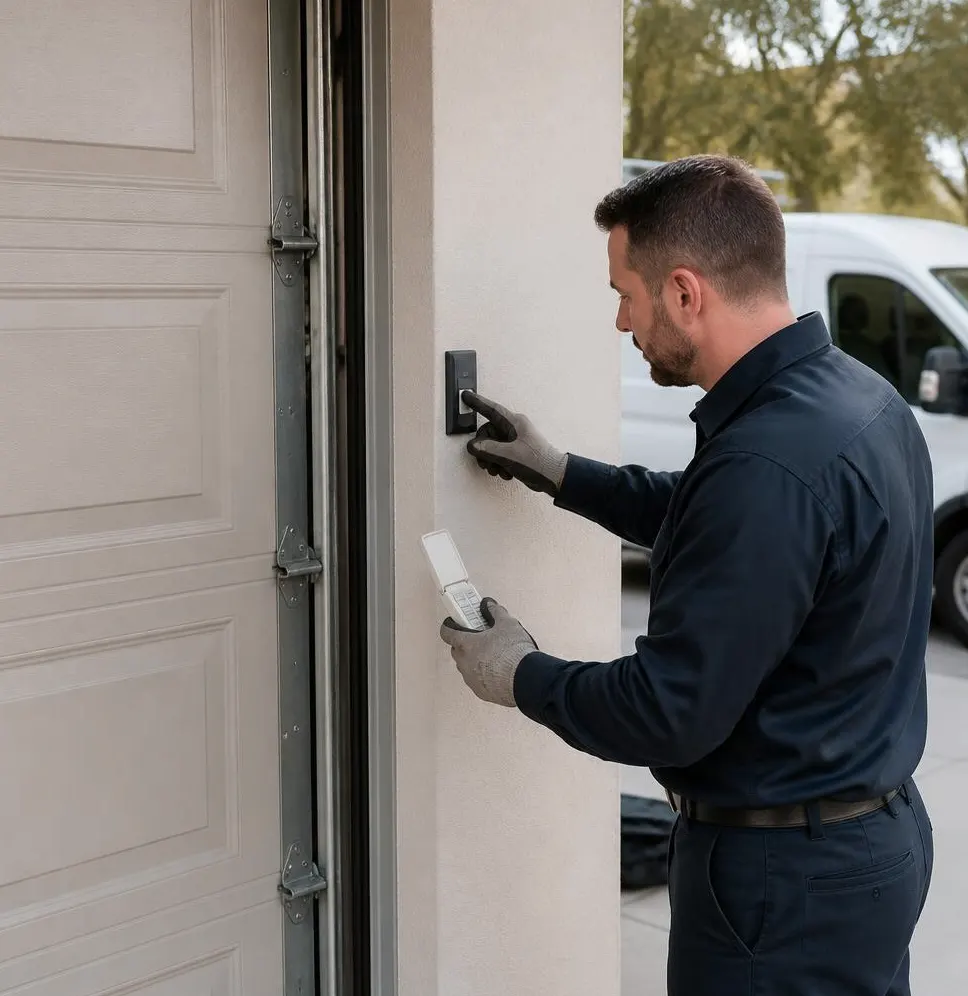
You hit the remote on your way out and the opener groans, stutters, then stalls halfway up. Or maybe the light flickers, the door reverses for no reason, or the chain rattles louder every week. That moment in the driveway — running late, door stuck — is when most homeowners start wondering whether it's time to call for a repair or just replace the whole unit.
The honest answer depends on the opener's age, what's actually failing, and how it's held up against the humidity and storm cycles this area throws at it. Here's how to think through the decision.
What usually goes wrong first
- Worn drive gear or chain: grinding noise, door moves slowly or not at all
- Failing capacitor or circuit board: opener hums but door doesn't move, or works intermittently
- Misaligned or dirty safety sensors: door reverses before touching the floor, often worse after heavy rain splashes dirt onto the sensor eyes
- Dead or corroded remote/keypad connections: inconsistent response, especially after humid stretches
- Motor struggling under load: often not the opener's fault at all — a swollen wood door or rusted hinge is adding resistance, and the motor is just the part that gives up first
That last point matters a lot here. Humidity swings make wood and composite doors swell and bind in their tracks, and salt-tinged air accelerates rust on hinges and rollers. If the opener is working harder than it should because the door itself is dragging, replacing the opener alone won't fix the underlying problem.
The case for repairing
- Typical repair costs run roughly $100–$300 for sensor alignment, capacitor replacement, gear kits, or remote reprogramming — a fraction of a new unit
- Makes sense if the opener is under 8–10 years old and the failure is isolated to one component
- Keeps a unit you already know works with your existing remotes, keypad, and smart home setup
- Buys time if you're not ready for a bigger expense this season
Where repair falls short
- Older circuit boards and logic units get harder to source parts for as models age out
- A unit that's already failed once tends to fail again within a year or two, especially one that's absorbed several humid summers and storm-season power fluctuations
- Repeated service calls for the same aging opener add up faster than people expect
The case for replacing
- New openers (roughly $300–$600 installed for a mid-range belt or chain-drive unit) come with battery backup as standard — a real advantage here, since storm-season outages can leave a door stuck shut or open with no way to operate it manually without one
- Quieter belt-drive motors run cooler and put less strain on components during peak summer heat
- Updated safety sensors and rolling-code security are harder to bypass and more reliable in damp conditions
- A fresh install resets the clock — no guessing which part will fail next
Where replacement costs more upfront
- Full unit plus installation costs more than any single repair
- If the real issue is a dragging door or worn springs, you still need that addressed separately — a new opener won't fix a mechanical problem elsewhere in the system
The five-year math
An opener past the 10-year mark that's already needed one repair is statistically likely to need another within two to three years, particularly with the heat cycling and moisture exposure typical of this climate. Stack two or three repair visits over five years against the cost of one new unit with a warranty and battery backup, and replacement usually comes out ahead — both in dollars and in how often you're stuck dealing with a stalled door during a downpour.
On the other hand, an opener under five years old with one isolated failure — a sensor knocked out of alignment, a blown capacitor — is almost always cheaper to repair. Don't replace a young, otherwise healthy unit over a single fixable issue.
What makes sense for a typical home here
For most homes in this area, the deciding factors are age and battery backup. If your opener is over 8 years old and lacks battery backup, replacement is usually the better five-year bet — hurricane season power outages make that feature worth the cost on its own. If it's newer and the problem is a single identifiable part, repair it and keep moving.
Either way, pair the opener decision with a look at the door itself. An opener fighting a swollen panel or rusted roller will burn through its lifespan faster regardless of how new it is.
When to call Land O' Lakes Garage Door
If you're hearing grinding, seeing inconsistent response from your remote, or dealing with a door that reverses on its own, our team can diagnose whether the opener, the sensors, or the door itself is the real culprit. We handle both Garage Door Opener Repair & Installation and Garage Door Maintenance, so if the opener turns out to be fine but the door is dragging from humidity swell or worn rollers, we can address that in the same visit instead of sending you back and forth.
If your opener is aging out and you want battery backup in place before storm season peaks, give us a call and we'll walk you through options that fit your door and your budget.
Reach out to Land O' Lakes Garage Door for a straight answer on repair versus replacement, and get it handled before the next stalled-door morning.